How to put garland and lights on a staircase banister (no damage)
Quick answer
Measure the rail from the bottom post to the end of the landing and buy that length plus 10–20% for swags. A typical 13–14 step rail is about 15 ft, plus about 3 ft for a short landing. Tie the garland to the rail every 2–3 ft with hook-and-loop ties, weave warm white mini lights through the branches, then add a bow every 3 ft with two berry picks at each bow.
We may earn a commission when you buy through our links, at no cost to you. How we pick
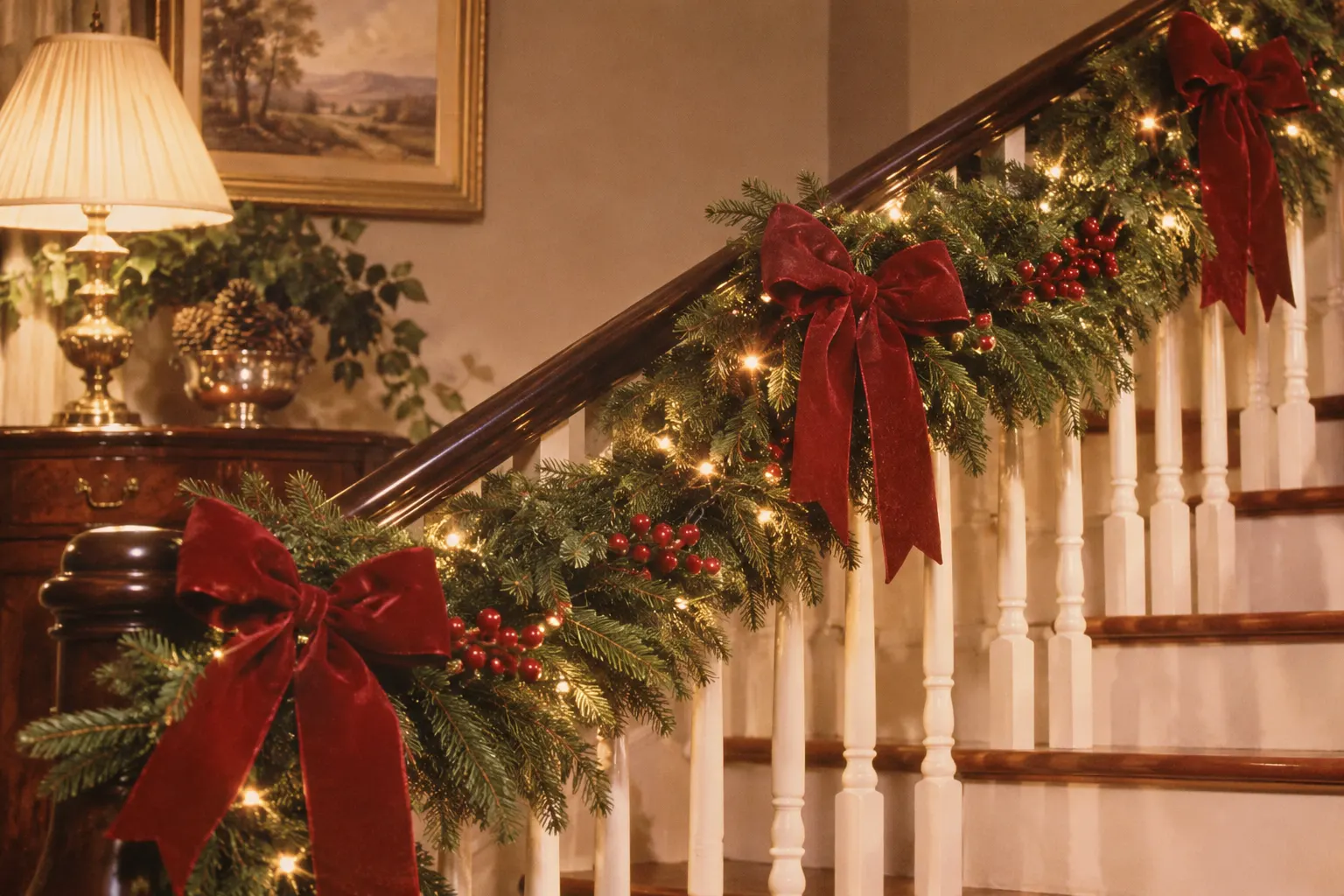
Tools
- Tape measure or string
- Scissors
Supplies
- Real-touch garland
- Warm white mini lights
- VELCRO One-Wrap ties
- Wired velvet bows
- Red berry picks
Step 1: Measure the rail
Run a string along the top of the handrail from the bottom post to the end of the landing, then measure the string. A tape on a slope lies.
Rough estimate: a 13–14 step staircase (10 in treads, 7.5 in rise) has about 14.5–15 ft of sloped rail. A short landing adds about 3 ft.
Step 2: Buy the right length and kind
| Look | Garland to buy |
|---|---|
| Laid straight along the rail | Rail length |
| Soft swags between posts | Rail length + 10–20% |
| Wrapped (spiral) | About 1.5× rail length |
Real-touch vs PVC: real-touch (PE) needles look like real greenery up close. Basic PVC tinsel-needle garland reads as plastic. On a banister you pass all day, real-touch is worth the extra.
Buy the main run first. Add a short piece for the landing only if it comes up short; a post between the sections hides small brand differences.
Step 3: Fluff every branch
Out of the box, garland is flat. Bend every tip out in a different direction: up, sideways, down. Fifteen minutes here makes a cheap garland look twice as full.
Step 4: Attach the garland without damage
- Lay the garland on top of the rail, not hanging under it.
- Tie it on every 2–3 ft with VELCRO One-Wrap ties (or soft twist ties). Hide each tie inside the branches.
- Start at the bottom post and work up, so gravity doesn't pull the slack down.
- Don't use tape (it lifts finish), adhesive hooks on paint, nails, or zip ties cinched hard against the rail.
Step 5: Weave in the lights
- Start at the end nearest an outlet so the plug is where you need it.
- Weave the string through the branches, not on top. The wire hides and the bulbs sit at different depths, which looks richer.
- Warm white (2700K) works with a multicolor tree. The banister frames the room; the tree is the colorful focal point. Multicolor on both competes.
- Match wire to rail: black wire on dark rails, green on light ones.
- About 100 mini bulbs covers 20 ft of garland generously.
Step 6: Add bows
- One bow every 3 ft: about 5 on a typical rail, plus one on the newel post.
- Twist the bow's back wire around the garland, not the rail, so nothing scratches the finish.
- Deep red velvet stays rich under warm light. Bright red drifts orange, and gold disappears next to amber bulbs. Use gold as small accents only.
Step 7: Tuck in berry picks
- Two picks per bow, one each side, angled outward. Six bows means about 12 picks.
- Plain bright red contrasts with deep red bows. Skip glitter, sugared and frosted berries: they shed.
- Skip picks with greenery attached; the garland is already green.
Step 8: Check safety
- Toddlers: berries are small round balls, so they're a choking risk. Tug-test every pick and keep picks on the upper side, out of reach.
- Use LED mini lights; they stay cool against dry garland.
- Put the lights on a timer or smart plug so they're off overnight and when you're out.
- Keep the garland clear of the handhold if anyone needs the rail to climb safely.
Questions people ask about this
How much garland do I need for a staircase banister?
Measure the rail with a string from the bottom post to the end of the landing, then add 10–20% for swags. A typical 13–14 step staircase has about 15 ft of sloped rail, plus about 3 ft for a short landing, so 18 ft usually covers it. See the banister guide.
How do I attach garland to a banister without damaging it?
Tie it on every 2–3 ft with hook-and-loop ties like VELCRO One-Wrap, hidden in the branches. Avoid tape, adhesive hooks on painted rails, nails, and zip ties pulled tight against the finish.
Is real-touch garland worth it over cheap PVC garland?
On a banister, yes. You see it up close every day, and real-touch (PE) needles look like real greenery while basic PVC reads as plastic. Outside or high on a mantel, the cheaper garland is fine.
How many bows should go on a staircase garland?
About one every 3 ft: five on a typical rail plus one on the newel post. Use large (10–12 in) wired velvet bows; small tree bows look lost on a staircase. Twist the wire around the garland, not the rail.
Red or gold bows with warm white lights?
Red, and preferably deep red. Gold bows nearly vanish next to amber-warm bulbs at night. Bright red shifts toward orange under 2200–2700K light, while deep red velvet stays rich. Use gold only as small accents, like a few ornaments tucked in at each bow.
How many berry picks do I need for a banister garland?
Two per bow, one on each side angled outward: about 12 for six bows. Use plain bright red picks around 10 in long. Skip glittered or frosted berries, which shed, and picks with greenery already attached.